Electrifying a machine is not a purchasing decision, it is an engineering project. We run it with you: one partner for pack, motor and controller, one CAN bus, and the integration risk on our side of the table.
We start from your goal: which machine, what it must deliver, and whether the platform fits. You get a written fit assessment within a week, including what would need adapting.
Mechanical integration, gearbox selection (standard 1:10 with our 1,500 rpm motor, or direct drive), CAN interface (pack handshake, power limits). Under a joint development agreement the pack can be adapted to your platform.
Evaluation kit: motor and controller sample sets for your build, a form-and-weight pack dummy, and a working pack demo at Kiwi or supervised on your site.
We help get the system running on your prototype and tune it together until it performs: current limits, torque behaviour on tool contact, thermal margins, charging.
Series supply of packs, motors and controllers from our EU hub in Dordrecht. Pack-level certification (UN 38.3, CE under Battery Regulation 2023/1542) is our responsibility; test reports and declarations ship with every batch for your machine CE file.
For OEMs that co-develop a first machine with us.
Your machine design stays yours; the platform, firmware and parameter sets stay with Kiwi.
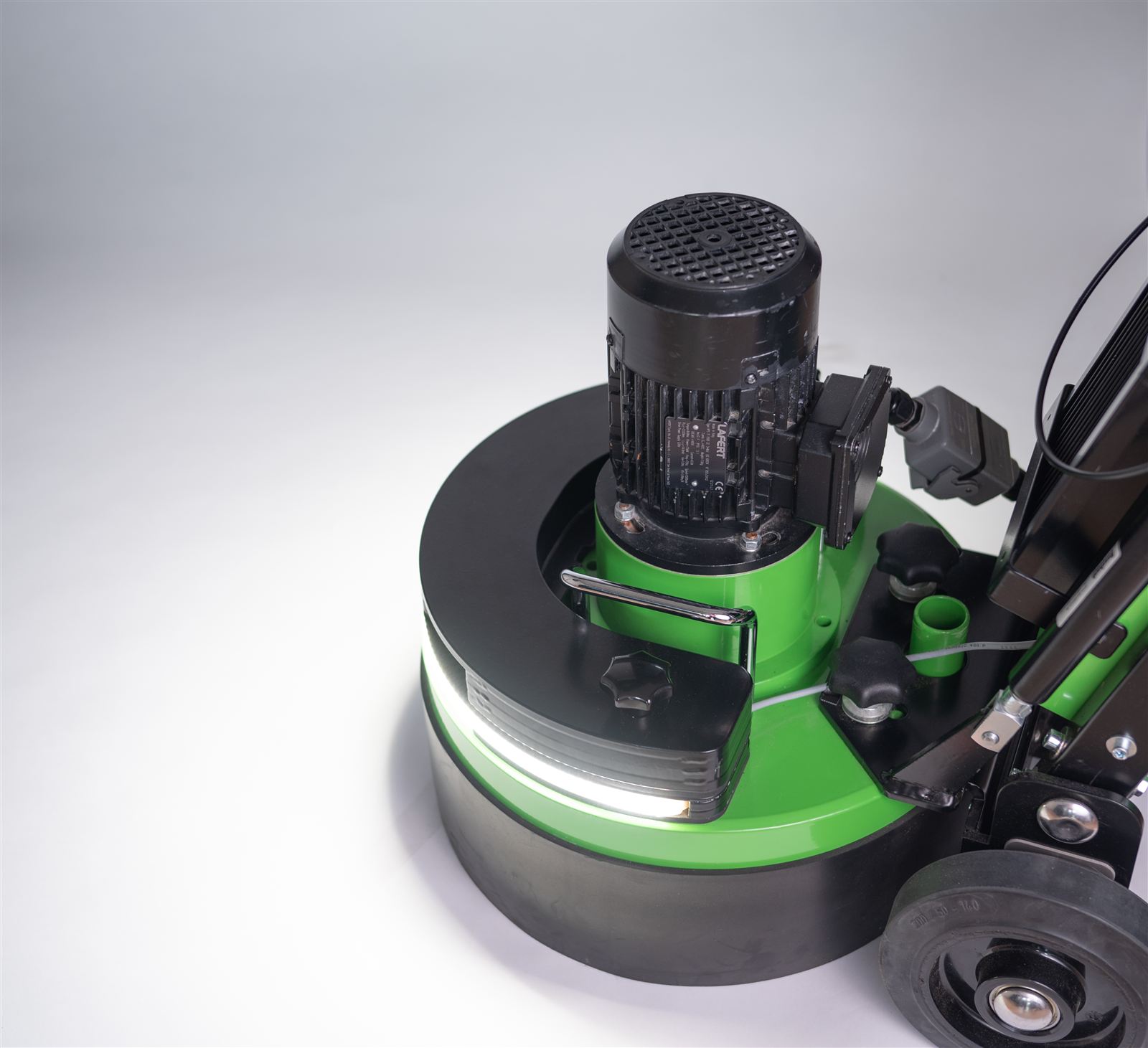
The horseshoe pack, the motors and the controller are a platform, not a catalogue. Under a joint development agreement we adapt them to what your machine needs.
Bore, height and mounting interface of the pack tailored to your head and frame. Lateral mounting is in development for machines where the motor does not sit on top of the head.
1.0 or 1.5 kWh, and BMS current limits set for your duty cycle: a scrubber that runs all shift at moderate load asks something different from a grinder that works in bursts.
1500 or 3000 rpm motor, direct drive or standard reduction, shaft and flange to your head. We select the drive that keeps your existing head and tooling.
The pack handshake, power limits and diagnostics mapped onto your machine controller and display. CAN specification and DBC under NDA; SAE J1939 alignment on the roadmap.
Charger selection and charging strategy set by the pack BMS. The optional hybrid power module (battery plus mains) for continuous uptime is in development.
Pack-level UN 38.3 and CE under the Battery Regulation are ours. For your machine CE file we supply the test reports, declarations and the documentation your notified body asks for.
We are machine builders ourselves, so we know what a supplier promise is worth once the prototype is on the floor. A few rules we work by:
We supply matched drive sets (motor plus controller with CAN firmware), not bare motors. A characterised set runs first time and is ready for the pack later. See drive sets.
Case by case. The drive set is characterised for the Kiwi pack; for another battery we set the current limits and the CAN behaviour for that pack as part of the project. The Kiwi pack itself only works with a Kiwi controller.
Pack-level certification (UN 38.3, CE under the Battery Regulation) is ours, and the reports ship with every batch. Machine CE remains your process; we supply the documentation your file needs.
Fit check within a week. Evaluation kit and first tuning within the quarter, depending on the machine. Pilot series and series supply follow the joint development plan we agree in step 2.
Yes. Series supply runs from our EU hub in Dordrecht; evaluation and demonstrations take place in Dordrecht or supervised on your site.