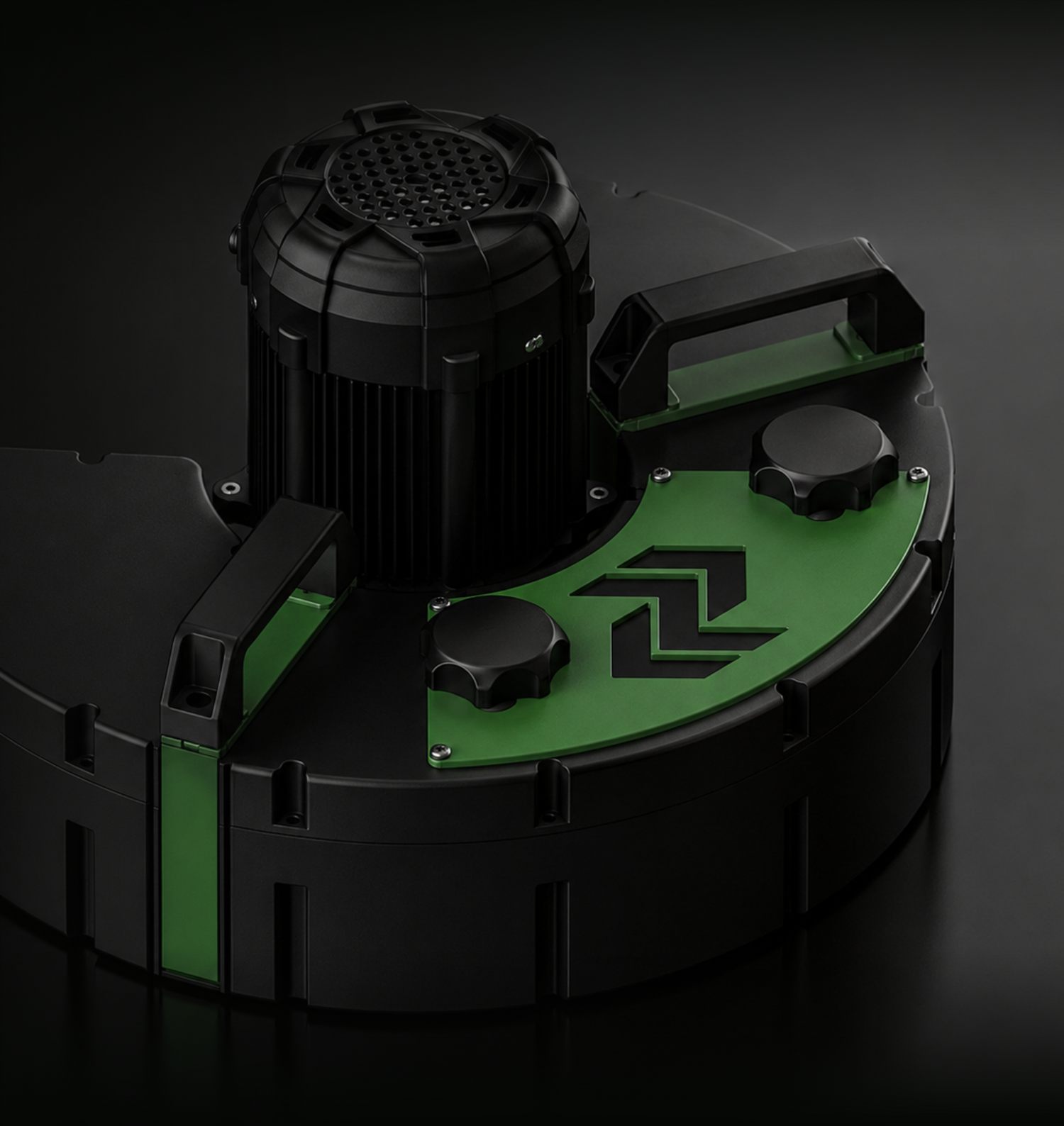
A horseshoe LFP battery pack around the drive motor, with matched motor and controller on one CAN bus. The mass adds head pressure, the balance stays fixed and the centre of the machine stays free.
A sander, grinder, scrubber or trowel presses a tool onto the floor. Its weight is not a burden to be minimised, it is the working force, and the operator has learned exactly how the machine balances. A generic battery block bolted to the frame or the handle breaks that: weight in the wrong place, a new balance, a centre crowded with cells.
That is why the professional floor-machine market is still corded, and why most compact scrubbers still carry lead-acid. Not for lack of cells, but for lack of a battery that respects the machine.
LFP, 16S, 48 VDC. 1.5 kWh for full-shift sanding and grinding, 1.0 kWh in development for lighter drives. One housing, two capacities, always below 60 V DC and under the 2 kWh battery-passport line.
Battery pack1.5 kW in two speeds: 1500 rpm for direct drive or a standard 1:10 reduction, 3000 rpm for geared drives. 6.5 kg, IP65, one flange and shaft for both. No custom high-ratio gearbox.
Drive motorsSine-wave FOC controller characterised for both motors, current limits matched to the pack, and one CAN bus for pack, controller and machine: state of charge, power limits, diagnostics.
Controller and CANMost compact-machine OEMs do not have an in-house battery and drivetrain team. With component suppliers, the integration work, and the risk, lands on your desk. Kiwi engineers the pack, motor and controller as one system and supports your team hands-on at every step.
Ship cordless machines ahead of the field: no cord over the finished floor, no site-power limits, quieter indoor work. To our knowledge, no major floor-sanding brand offers a cordless professional machine today.
We know sanding and grinding from the inside. Our own prototypes prove the platform under real load on wood, stone and concrete; your machines are how it scales.
Your machine design stays yours; the platform, firmware and parameter sets stay with Kiwi. Launch partners get a protected, time-limited window in their machine category and first access to evaluation kits and engineering hours.


Which machine, what it must deliver, and whether the platform fits. Written assessment within a week.
Mechanical integration, gearbox selection, CAN interface. Under a JDA the pack can be adapted to your platform.
Evaluation kit: motor and controller sample sets, a form-and-weight pack dummy, a working pack demo at Kiwi or supervised on your site.
We get the system running on your prototype and tune it together until it performs.
Series supply from our EU hub in Dordrecht, with pack-level certification and documentation for your machine CE file.
Start with a matched drive set (motor plus controller with CAN firmware) to take a mains machine to 48 V, or with the evaluation kit to test the platform on your own machine. Every component is a platform component: it grows into the complete system without a redesign.
Components and drive setsPack geometry, capacity and current profile, drive and gearing, CAN mapping and charging adapted to your machine under a joint development agreement.
Custom systemsDC in every state. A 16S LFP pack never exceeds 58.4 V, so the machine stays under the SELV threshold.
Per pack. No EU battery passport required under Regulation 2023/1542; pack CE and UN 38.3 are ours.
For pack, controller and machine. State of charge, power limits and diagnostics as one dataset.
Standard reduction with the 1500 rpm motor gives 150 rpm at the disc. Or direct drive for stone grinders.